

As electric vehicles become more common on American roads, so does a familiar accusation: EV drivers aren’t paying their fair share for the infrastructure they use. But that claim doesn’t hold up to scrutiny. From road wear to registration fees and how highway funding works, the facts, backed by data, show that most EV drivers are actually paying as much or more than gas-car drivers. Here are answers to commonly asked questions about EV taxes.
Since EVs don’t use gas, they don’t pay into the federal Highway Trust Fund (HTF). Isn’t it unfair that gas cars contribute, and EVs don’t?
Currently, highway infrastructure is largely funded by two separate gas taxes: a state gas tax that varies by state and a federal gas tax that funds nationwide infrastructure through the Highway Trust Fund. In general, only about one-fifth of highway infrastructure investment comes from the federal government. Nearly 80% of highway spending is paid for using a diverse mix of state gas taxes, state vehicle registration and licensing taxes, municipal bonds, tolls, and other taxes.
While EV drivers don’t currently pay into the federal Highway Trust Fund, they do pay EV taxes to register their vehicles in 41 states. These state EV fees often cost much more than the average gas car driver pays in gas taxes. In some cases, these registration taxes cost EV drivers thousands of dollars more over the life of their vehicle than what gas car drivers pay. Since most infrastructure is funded by states and EVs often pay more at the state level, they are already contributing as much, or more, than most gas cars.
There is also something to be said for the fact that poisonous tailpipe pollution from gas vehicles costs taxpayers, including EV drivers, billions of dollars in healthcare costs, lost workdays, and premature deaths. Overall, EVs save families money on healthcare costs and improve quality of life because they don’t emit pollution while operating, contributing to cleaner air.
Are the EV taxes in the BUILD America 250 Act fair?
The EV tax in the BUILD America 250 Act is not fair. Gas car drivers pay about $85 a year into the Highway Trust Fund, and the BUILD America 250 Act proposes EV drivers pay $130 initially, which increases each year to $150.
The bill also strips billions of dollars in funding for EV charging and clean transportation options, such as electric transit buses, port and ferry electrification, and healthy streets programs. EVs are already paying more in taxes in many states. If EVs are paying federal taxes, the bill should include funding to build out EV charging infrastructure on highways and in communities.
As shown in the first map below, EV drivers are already penalized and pay more than gas-vehicle drivers in 26 states. If EV drivers are also required to pay $130 a year in a federal tax, EV drivers will pay more in 39 states and D.C, as illustrated in the second map. The darker the red, the more EV drivers pay in taxes than gas-vehicle drivers.
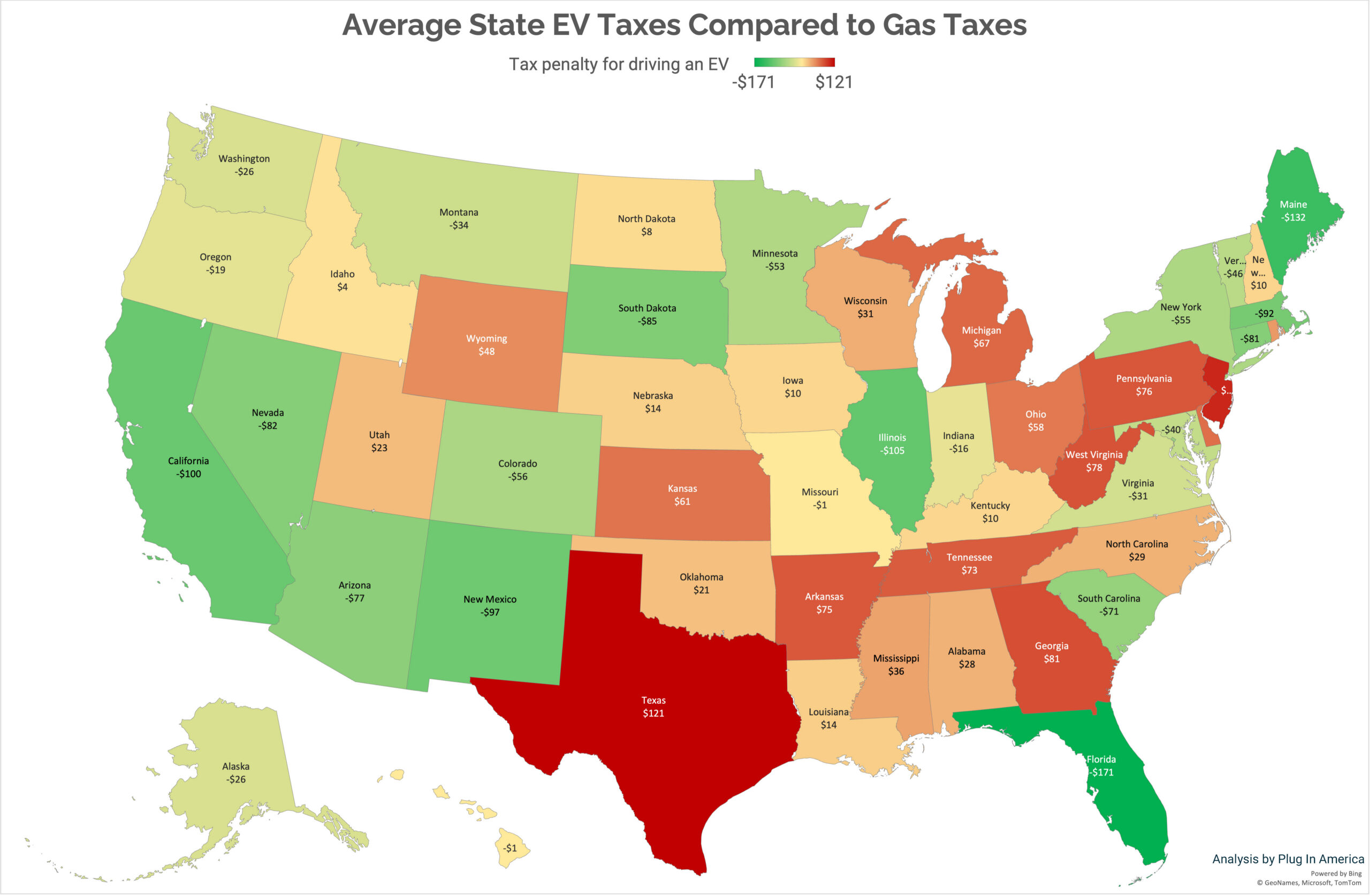
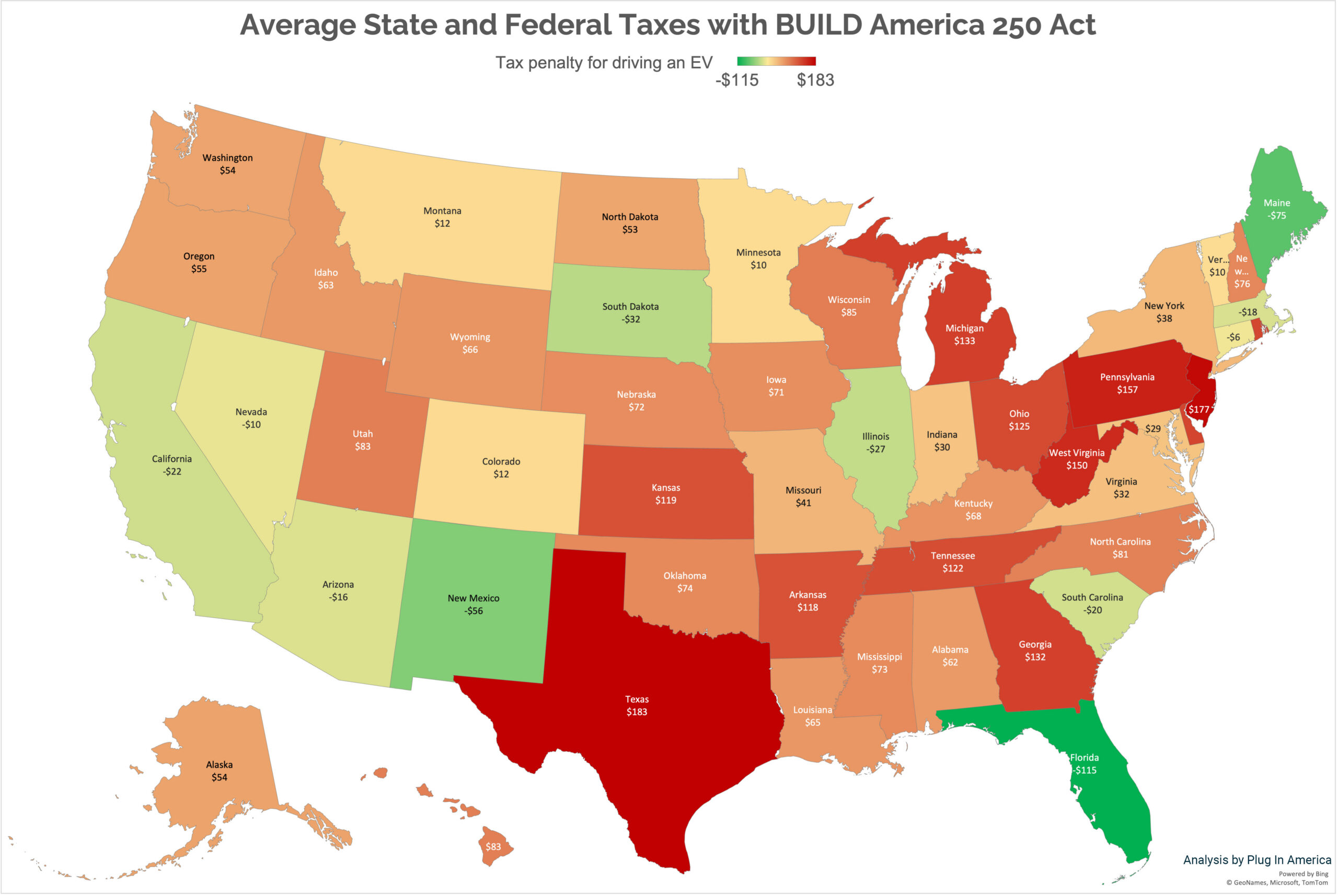
Methodology and assumptions for both maps: Analysis limited to all-electric vehicles, not plug-in hybrid electric vehicles or hybrids. Gas vehicle fuel economy is from most recent EPA estimated real-world fuel economy (2025). Average per capita vehicle miles traveled for each state is from Federal Highway Administration Table PS-1. State EV registration fee taxes are from from the National Conference of State Legislatures as of January 2026. Battery-electric vehicle efficiency is assumed to be 3 miles per kWh. Where EV registration fees are collected on a timeline other than annually, they have been adjusted to annual values for consistency. The information included is for general informational purposes only and should not be construed as legal, tax, or other advice. Contact the appropriate state agencies for official information or guidance about motor fuel taxes and fees.
The stated purpose of introducing EV taxes is to address a shortfall in the Highway Trust Fund of over $30 billion per year. Since EVs make up about 2% of vehicles on the road, EV taxes will cover only a tiny fraction of that shortfall.
The reason that the Highway Trust Fund has a deficit to begin with is that the federal gas tax hasn’t increased since 1993. For context, the No. 1 hit song in 1993 was Whitney Houston’s “I Will Always Love You,” the first Jurassic Park movie was released, and the World Wide Web went public – the iPhone didn’t show up for another 14 years. Inflation and construction costs have grown over the last 33 years, but the gas tax rate has stayed flat, creating a huge deficit.
If the true intent of Congress was to make the Highway Trust Fund solvent, the way to do that would be to increase the gas tax and create a fair tax for EV drivers.
Since EVs weigh more than gas cars, shouldn’t they pay more for roads?
While EVs typically weigh 25% to 30% more than comparable gas cars, passenger vehicles contribute minimally to road damage. Even the heaviest passenger EV on the road, the EV Hummer, falls into this category.
Studies attribute the vast majority of road wear to heavy-duty vehicles such as 18-wheel trucks. One study on the cost of road maintenance due to the increased weight of battery and hydrogen trucks found that vehicle classes with a typical weight of under 12 tons (24,000 pounds) have a negligible impact on road wear on a national scale. Since consumer EVs fall in the light-duty vehicle category, meaning they weigh under 10,000 pounds, there is no merit to the argument that passenger EVs cause more road wear than gas vehicles.
In light of high gas prices and the affordability crisis, isn’t it a bad time to increase the gas tax?
It’s a bad time to raise any tax. EVs are one of the few ways American families and households can control spending right now. The EV market is maturing, and late-model used EVs are entering the used-vehicle market as they come off leases. Used EVs cost about the same as used gas cars but are a better value because they are often newer years, packed with cool technology features that you might have to pay extra for in a gas car, have lower mileage, and offer better warranties. Adding a federal annual tax for EVs may push them out of reach for drivers who could benefit most, while keeping drivers dependent on expensive gas burners.
What is a “fair” EV tax?
Plug In America has found that EV drivers are willing to contribute to infrastructure costs. We believe the total amount that drivers pay in EV taxes at the state and federal levels should not exceed what gas-vehicle drivers pay in state and federal gas taxes.
Ultimately, combined EV taxes and electricity taxes at the state and federal levels should be capped at the total amount gas car drivers pay in gas taxes at the pump.
Take 30 seconds and tell your Congressperson to vote no on the BUILD America 250 Act.


